Upper Dolpo Trekking - 21 Days
A journey shaped by the landscapes, people and experiences of Nepal.
Offered by Thulo Travel Services Pvt. Ltd.
 NEPAL · TRAVEL EXPERIENCES
Discover the journey
Dolpo region is situated between the Tibetan plateau and the Dhaulagiri ranges. The entire district was closed to trekkers until 1989 when the southern part of Dolpo was opened to organized trekking groups.
The memorable moments
Highlights
Journey at a glance
Day Day 24: Trek to Dunai (2140m) — We begin our trek on a trail behind the Bheri River before crossing a bridge near the Lawan village. Our trail will continue alongside the big Bheri River ascending until the Byas Gadi. From here the trail moves towards the west on a relatively easy trail. We cross the river again near the Lochakhola Gaon and ascend to Dunai for an overnight stay. Today’s trek will mostly be on a wonderful gorge with pine trees. Day Day 1: Arrival in Kathmandu — Flying into Kathmandu, you'll have views over the valley, the Himalaya, and the terraced fields below. After completing customs, a representative will be waiting to greet you outside the airport and to guide you through the initial culture shock of Kathmandu’s narrow, winding streets to your hotel. Day Day 25: Trek to Juphal — From Dunai, we trek along the Bheri River enjoying the beautiful landscape. On the way, we pass through Dhupichaur and Rupgad villages as well as a temple. We continue trekking via Kalagaonda village and Motipur village before reaching the small airstrip. Day Day 2: Permit Preparation and trek Briefing — Today is a free day for you. you can either stay at the hotel and relax or you can explore the Kathmandu city on your own. on your request, we can also arrange the full guided sightseeing tour for you. As for the restricted permit, We will need your original passport to issue the restricted trek permit. you can hand over your original passport to our office representative at the time of your arrival. In the evening, You will have a short trek briefing. we will introduce you with your trek guide and hand over your passport at the same time. Day Day 26: Fly Juphal to Nepalgunj and then to Kathmandu. — We take the earliest flight from Jhupal to Nepalgunj. Upon reaching Nepalgunj, we return to Kathmandu on the next available flight. After arriving in Kathmandu, we will be transferred to our hotel. Day Day 3: Fly Kathmandu to Nepalgunj (492m). — Take an hour-long flight from Kathmandu to Nepalgunj, located in Western Nepal. Nepalgunj, a town near the Nepal-India border, is also the gateway to Simikot, Humla. The town itself is an interesting Terai town that showcases the diverse culture of Nepal. In Nepalgunj, you can visit the local market, mini-zoo and nearby villages on own. Day Day 27: Depart Kathmandu — It's time to say farewell to Nepal. Enjoy your last moments in Kathmandu with breakfast in a café, a final stroll through the narrow alleys and temples, and some final souvenir shopping. A driver will be waiting for you at your hotel to take you to the airport for your return flight home. It's best to be at the airport at least two hours prior to departure. Day Day 4: Fly Nepalgunj to Juphal (2500m). Trek to Dunai (2140m) — After breakfast, fly to Jhupal. The town is beautifully located over the Himalayan foothills, with views of Annapurna and Dhaulagiri peaks to its north. We walk through terraced fields to the Bheri River and its narrow gorge. We continue walking to Dunai, which is the administrative headquarter of the Dolpo region. We explore the small town in the evening and camp there for the night. Day Day 5: Trek to Ankhe (2660m) — We leave Dunai and cross a suspension bridge and turn to the west following a trail past a hospital. The trail ascends up the side of the treeless, Thulo Bheri valley before entering Phoksundo river valley. During the walk, we get to the view of Kagmara Peak up the valley. We pass through walnut groves, Dhera and Rahagaun villages, walk down dense jungles and finally reach Ankhe. Day Day 6: Trek to Sulighat (3500m). — Our trail ascends and descends along a wooded riverbank and climbs on a steep trail. The ups and downs can be a bit monotonous, but there are several streams along the way that offer a chance to cool off. The trail eventually leaves the forests and passes through a grassy slope high above the river. We trek downhill on a trail surrounded by lush forests before reaching a cliff followed by a dizzying drop on a wobbly stone staircase to the river bank. We continue trekking until we reach Sulighat where we spend the night. Day Day 7: Trek to Phoksundo Lake (3600m). — We continue our journey along the valley floor to the confluence of the Phoksundo and Pungmo rivers. After crossing a bridge, we walk on the western bank of the Pungmo Khola. The trail passes through a cedar forest before reaching Palam village. From here we trek up to a ridge and enjoy distant views of Phoksundo Lake and a spectacular waterfall, one of the highest in Nepal. Next, our trail descends through birch forests to the upper reaches of the Phoksundo Khola, and then to the picturesque Ringmo village with its mud-plastered chortens and mani walls. From here it is a short walk to the shores of the Phoksundo Lake. Day Day 8: Restday at Phoksundo Lake (3600m). — Today will be a well-deserved rest day for acclimatization at Phoksundo Lake. During the day we can embark on a short hike to the village of Ringmo and it’s Tibetan Buddhist Monastery. During our short walks, we also get a chance to get acquainted with the local culture. The Dolpo people wear homespun clothing that is sometimes dyed a maroon color and they favor Tibetan-style somba or dhocha (boots with upturned toes) for footwear. Both men and women often wear religious amulets and strings of coral, amber, and turquoise. Day Day 9: Trek to Phoksundo Khola (3500m). — Our trail moves around the top western end of the Phoksundo Lake as it contours on a rocky ledge along the lake’s western bank. This unsteady trail suspended on a gangway of wood supported on pegs driven into crevasse in the rocks, signals the remoteness of the area we are about to enter. At the westernmost edge of the lake, the path leads through a lush meadow that opens up into the flood plain of the Phoksundo Khola. Then we walk through the valley, crossing the river and avoiding the occasional boggy marsh underfoot and then coming on the bank of the river to the overnight camp. Day Day 10: Trek to Phoksundo Bhanjyang (4402m). — For an hour or so we walk on a trail that leads us along the level path through a glacial valley which heads due north. At the confluence of the Phoksundo Khola and another mountain stream, there is an old wooden bridge. From here, we walk towards the north-east. A long climb brings us to a sheep meadow where our trail veers up a steep ravine. A hard climb to the top brings us to yet another valley where we can see the Kang-La pass. We set up our camp near the pass in a place that Peter Matthiessen christened 'Snowfields Camp'. During our trek today we also get to admire the views of Chhamlang peak 6 (6739m) and peak 7 (6105m). Day Day 11: Trek to Shey Gumpa (4126m) via Kang La pass (5151m) — In the morning, we ascend on a steep trail littered with slate towards the pass. The climb to the top of the pass is quite strenuous. From the top of Kang-la pass, we get excellent views of the large valley dissected by a gushing river. We descend to the valley floor on a steep trail. Next, we walk on a meandering trail along the banks of a river, crossing and re-crossing it several times. There are mud caves lining the hills overlooking the river. We also pass through meadows where we see grazing yaks, hundreds of sheep and domestic mountain goat (Chyangra). After crossing a quaint log bridge we reach the Shey Gompa compound where we will be spending the night. Day Day 12: Restday at Shey Gumpa (4126m) — Shey Gompa was built in 1655 and the monastery is noted for its giant copper with a gilded gold statue of a seated Shakyamuni Buddha. To the east of the gompa is Crystal Mountain which is one of the strangest mountains, as its contorted cliffs are laced with quartz and embedded with a rich variety of marine fossils. Today is another well-earned rest day for acclimatization. We spend the day hiking around Shey village which is famous for its ancient pre-Buddhist culture, the Bon Po. In Dolpo, the ancient Tibetan way of life combines animism with the teaching of Buddha. Overnight in Shey Gompa. Day Day 13: Trek to Namduna Gaun (4400m) via Saldang La (4785m) — We begin the day by following a pleasant trail amidst juniper trees which descends into a grey, stone canyon. Then the path begins to zigzag over bare rocks and coarse eroded soil until it eventually brings us to the top of Saldang-la pass. The subsequent descent towards the north is long and tiring but grazing yaks and sheep, and nomadic tents made from yak hair is a comforting sight. In Namduna Gaun we visit Namgung monastery. The red stone monstery is built against the backdrop of a cliff on the north wall of a gorge. Day Day 14: Trek to Saldang (3903m) — We leave the village and climb up a slope and begin a long walk along dusty barren mountains. After 3-4 hours of hard climb, we begin to see Saldang Village below us on a plateau high above the Namga Khola stream. It has a picturesque appearance. Saldang is the largest village of the inner Dolpo area. The village stretches for nearly two kilometers on an open slope and consists of five villages having about eighty well-built houses with nearly six hundred people. It is a prosperous village not only agriculturally but also for its strategic location on a trade route to Tibet. Day Day: Trek to Sibu (3942m) — From Yangze, there are two trails that connect to Sibu. To save time we will retrace the path back towards Saldang village, which will be much easier and shorter than the other route. From Saldang we walk along a river and pass through terraced fields, stupas, chortens, heaps of mani stones and a Chaiba monastery, then pass through the Namdo village, which is also prosperous, with about sixty houses having nearly 400 inhabitants. It stretches for more than 5 km on the high slopes to the left of Nam Khong Khola. The Namdo monastery is located near the river bed. Our journey continues further down the river for another two hours to camp near a small settlement of Sibu. Day Day 17: Trek to Jeng-La Phedi (4369m) — We walk along the Nam Khong Khola for a while and pass by caravans with yaks that are moving towards the Tibetan border. After turning east and walking for a while, we arrive at a confluence of two small streams. Next, the steep trail ascends to a grazing area below the Jeng La pass (4,900m/16,072ft). Our camp will be set up in this beautiful meadow. Day Day 18: Trek to Tokyu Gaon (4209m) via Jeng pass (4369m) — We get up early in the morning and set forth on today’s trek. It will take us two long hours to reach the top of the Jeng La pass from where we get remarkable views of the north face of the Dhaulagiri massif. From here we descend on a rough trail to the Tarap Valley, a fascinating valley with vast plains in high mountains that extends twenty kilometers along Tarap Chu river. We will camp close to the monastery at Tokyu. Day Day 19: Trek to Dho Tarap (4090m) — We trek downhill on a plain valley with patches of lush grass on both sides of the river which is completely different from other parts of Inner Dolpo. There is also a marsh which is a common feature in the Desert Mountains of Tibet and the Ladakh Himalaya. Both the Bon Po and Buddhist sects are practiced in the valley. After a short trek, we reach Dho Tarap). Day Day 20: Restday in Dho Tarap (4090m) — We spend today resting and strolling in the village of Dho Tarap which is surrounded by an irregular stone wall. Our walks will help us get acquainted with the local culture of the area. At Dho, about 40 houses are divided into three clusters and built in a haphazard way inhabited by few Tibetans and mostly Magars who are a hill tribe of Nepal. While here, we can visit a Buddhist Gompa which is closest to our campsite or we could embark upon a 40-minute walk and visit a Bon Po Gompa. Day Day 21: Trek to Tarap Khola (3800m) — From Tarap we descend towards a wide valley which eventually narrows into a gorge. We walk along with juniper and wild rose bushes just above the tree line. On our trek, we see herds of blue sheep and by the afternoon, we reach the confluence of the Tarap Chu and the Lang Khola, a stream that joins with Tarap River from further east. We will make our camp on a nice meadow also known as Kamakharka and spend the night. Day Day 22: Trek to Khani Gaon (2550m) — We continue walking down the gorge of the Tarap River, at times alongside it. During our walk, we pass by the local people who will be taking their herds to lower pastures for the winter. This will be one of the most exciting days of this trip as the valley becomes so narrow in a deep gorge that in some places we can jump from one side to another. Sometimes there is no trace of a path and we may have to walk across stone slabs fitted on logs in between the walls which act as a bridge. The gorge also provides unexpected adventure and thrills. At some places, the bridges are either damaged or washed away and we may be forced to cross the icy torrent on foot. Finally, we reach our camping spot beside the Tarap Khola at Khanigaon where we spend the night. Day Day 23: Trek to Tarakot (2281m) — From the camp, we follow a trail that takes us to the village of Lalberi. Our trail then passes through a lush forest, descends into another gorge and continues to follow the river again. After reaching Tarakot, we can visit Sandul Gompa which lies about 8 km east of the village at a juncture of Barbung Khola and Tarap Chu. The monastery stands on a hill to the south of Bheri River. Today we camp by the Tarap Chu river about 150 meters below Tarakot, near the police post. Day Day 24: Trek to Dunai (2140m) — We begin our trek on a trail behind the Bheri River before crossing a bridge near the Lawan village. Our trail will continue alongside the big Bheri River ascending until the Byas Gadi. From here the trail moves towards the west on a relatively easy trail. We cross the river again near the Lochakhola Gaon and ascend to Dunai for an overnight stay. Today’s trek will mostly be on a wonderful gorge with pine trees. Day Day 25: Trek to Juphal — From Dunai, we trek along the Bheri River enjoying the beautiful landscape. On the way, we pass through Dhupichaur and Rupgad villages as well as a temple. We continue trekking via Kalagaonda village and Motipur village before reaching the small airstrip. Day Day 26: Fly Juphal to Nepalgunj and then to Kathmandu. — We take the earliest flight from Jhupal to Nepalgunj. Upon reaching Nepalgunj, we return to Kathmandu on the next available flight. After arriving in Kathmandu, we will be transferred to our hotel. Day Day 27: Depart Kathmandu — It's time to say farewell to Nepal. Enjoy your last moments in Kathmandu with breakfast in a café, a final stroll through the narrow alleys and temples, and some final souvenir shopping. A driver will be waiting for you at your hotel to take you to the airport for your return flight home. It's best to be at the airport at least two hours prior to departure.
Day-by-day itinerary
Day 24Trek to Dunai (2140m) — We begin our trek on a trail behind the Bheri River before crossing a bridge near the Lawan village. Our trail will continue alongside the big Bheri River ascending until the Byas Gadi. From here the trail moves towards the west on a relatively easy trail. We cross the river again near the Lochakhola Gaon and ascend to Dunai for an overnight stay. Today’s trek will mostly be on a wonderful gorge with pine trees.
Confirm daily arrangements with the provider.
Day 1Arrival in Kathmandu — Flying into Kathmandu, you'll have views over the valley, the Himalaya, and the terraced fields below. After completing customs, a representative will be waiting to greet you outside the airport and to guide you through the initial culture shock of Kathmandu’s narrow, winding streets to your hotel.
Confirm daily arrangements with the provider.
Day 25Trek to Juphal — From Dunai, we trek along the Bheri River enjoying the beautiful landscape. On the way, we pass through Dhupichaur and Rupgad villages as well as a temple. We continue trekking via Kalagaonda village and Motipur village before reaching the small airstrip.
Confirm daily arrangements with the provider.
Day 2Permit Preparation and trek Briefing — Today is a free day for you. you can either stay at the hotel and relax or you can explore the Kathmandu city on your own. on your request, we can also arrange the full guided sightseeing tour for you.
Confirm daily arrangements with the provider.
Day 26Fly Juphal to Nepalgunj and then to Kathmandu. — We take the earliest flight from Jhupal to Nepalgunj. Upon reaching Nepalgunj, we return to Kathmandu on the next available flight. After arriving in Kathmandu, we will be transferred to our hotel.
Confirm daily arrangements with the provider.
Day 3Fly Kathmandu to Nepalgunj (492m). — Take an hour-long flight from Kathmandu to Nepalgunj, located in Western Nepal. Nepalgunj, a town near the Nepal-India border, is also the gateway to Simikot, Humla. The town itself is an interesting Terai town that showcases the diverse culture of Nepal. In Nepalgunj, you can visit the local market, mini-zoo and nearby villages on own.
Confirm daily arrangements with the provider.
Day 27Depart Kathmandu — It's time to say farewell to Nepal. Enjoy your last moments in Kathmandu with breakfast in a café, a final stroll through the narrow alleys and temples, and some final souvenir shopping. A driver will be waiting for you at your hotel to take you to the airport for your return flight home. It's best to be at the airport at least two hours prior to departure.
Confirm daily arrangements with the provider.
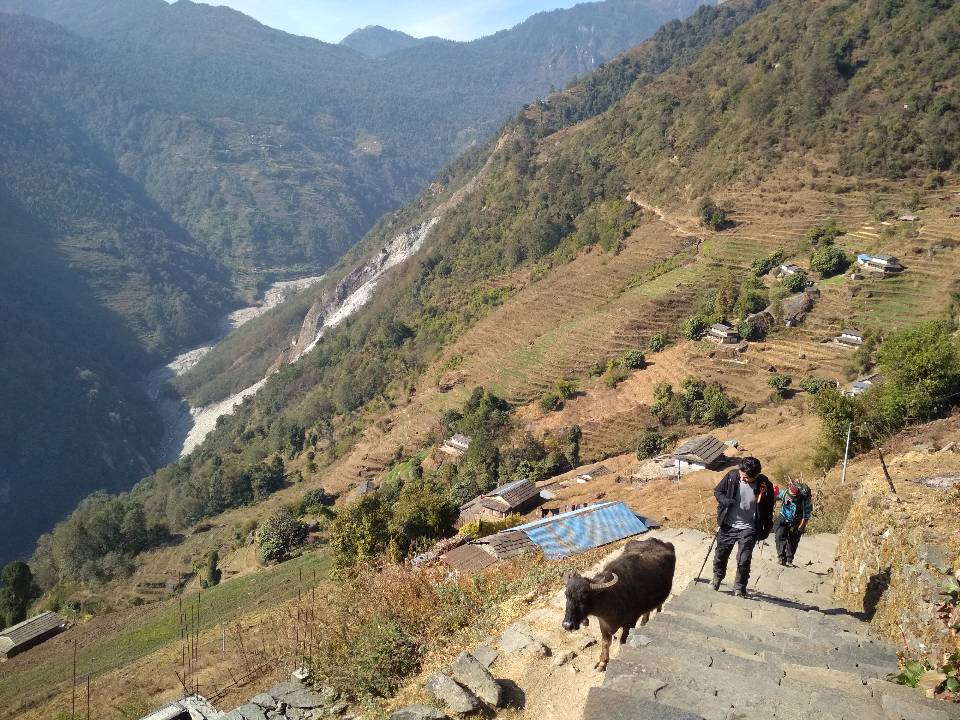
Day 4Fly Nepalgunj to Juphal (2500m). Trek to Dunai (2140m) — After breakfast, fly to Jhupal. The town is beautifully located over the Himalayan foothills, with views of Annapurna and Dhaulagiri peaks to its north. We walk through terraced fields to the Bheri River and its narrow gorge. We continue walking to Dunai, which is the administrative headquarter of the Dolpo region. We explore the small town in the evening and camp there for the night.
Confirm daily arrangements with the provider.
Day 5Trek to Ankhe (2660m) — We leave Dunai and cross a suspension bridge and turn to the west following a trail past a hospital. The trail ascends up the side of the treeless, Thulo Bheri valley before entering Phoksundo river valley. During the walk, we get to the view of Kagmara Peak up the valley. We pass through walnut groves, Dhera and Rahagaun villages, walk down dense jungles and finally reach Ankhe.
Confirm daily arrangements with the provider.
Day 6Trek to Sulighat (3500m). — Our trail ascends and descends along a wooded riverbank and climbs on a steep trail. The ups and downs can be a bit monotonous, but there are several streams along the way that offer a chance to cool off. The trail eventually leaves the forests and passes through a grassy slope high above the river. We trek downhill on a trail surrounded by lush forests before reaching a cliff followed by a dizzying drop on a wobbly stone staircase to the river bank. We continue trekking until we reach Sulighat where we spend the night.
Confirm daily arrangements with the provider.
Day 7Trek to Phoksundo Lake (3600m). — We continue our journey along the valley floor to the confluence of the Phoksundo and Pungmo rivers. After crossing a bridge, we walk on the western bank of the Pungmo Khola. The trail passes through a cedar forest before reaching Palam village. From here we trek up to a ridge and enjoy distant views of Phoksundo Lake and a spectacular waterfall, one of the highest in Nepal. Next, our trail descends through birch forests to the upper reaches of the Phoksundo Khola, and then to the picturesque Ringmo village with its mud-plastered chortens and mani walls. From here it is a short walk to the shores of the Phoksundo Lake.
Confirm daily arrangements with the provider.
Day 8Restday at Phoksundo Lake (3600m). — Today will be a well-deserved rest day for acclimatization at Phoksundo Lake. During the day we can embark on a short hike to the village of Ringmo and it’s Tibetan Buddhist Monastery. During our short walks, we also get a chance to get acquainted with the local culture. The Dolpo people wear homespun clothing that is sometimes dyed a maroon color and they favor Tibetan-style somba or dhocha (boots with upturned toes) for footwear. Both men and women often wear religious amulets and strings of coral, amber, and turquoise.
Confirm daily arrangements with the provider.
Day 9Trek to Phoksundo Khola (3500m). — Our trail moves around the top western end of the Phoksundo Lake as it contours on a rocky ledge along the lake’s western bank. This unsteady trail suspended on a gangway of wood supported on pegs driven into crevasse in the rocks, signals the remoteness of the area we are about to enter. At the westernmost edge of the lake, the path leads through a lush meadow that opens up into the flood plain of the Phoksundo Khola. Then we walk through the valley, crossing the river and avoiding the occasional boggy marsh underfoot and then coming on the bank of the river to the overnight camp.
Confirm daily arrangements with the provider.
Day 10Trek to Phoksundo Bhanjyang (4402m). — For an hour or so we walk on a trail that leads us along the level path through a glacial valley which heads due north. At the confluence of the Phoksundo Khola and another mountain stream, there is an old wooden bridge. From here, we walk towards the north-east. A long climb brings us to a sheep meadow where our trail veers up a steep ravine. A hard climb to the top brings us to yet another valley where we can see the Kang-La pass. We set up our camp near the pass in a place that Peter Matthiessen christened 'Snowfields Camp'. During our trek today we also get to admire the views of Chhamlang peak 6 (6739m) and peak 7 (6105m).
Confirm daily arrangements with the provider.
Day 11Trek to Shey Gumpa (4126m) via Kang La pass (5151m) — In the morning, we ascend on a steep trail littered with slate towards the pass. The climb to the top of the pass is quite strenuous. From the top of Kang-la pass, we get excellent views of the large valley dissected by a gushing river. We descend to the valley floor on a steep trail. Next, we walk on a meandering trail along the banks of a river, crossing and re-crossing it several times. There are mud caves lining the hills overlooking the river. We also pass through meadows where we see grazing yaks, hundreds of sheep and domestic mountain goat (Chyangra). After crossing a quaint log bridge we reach the Shey Gompa compound where we will be spending the night.
Confirm daily arrangements with the provider.
Day 12Restday at Shey Gumpa (4126m) — Shey Gompa was built in 1655 and the monastery is noted for its giant copper with a gilded gold statue of a seated Shakyamuni Buddha. To the east of the gompa is Crystal Mountain which is one of the strangest mountains, as its contorted cliffs are laced with quartz and embedded with a rich variety of marine fossils. Today is another well-earned rest day for acclimatization. We spend the day hiking around Shey village which is famous for its ancient pre-Buddhist culture, the Bon Po. In Dolpo, the ancient Tibetan way of life combines animism with the teaching of Buddha. Overnight in Shey Gompa.
Confirm daily arrangements with the provider.
Day 13Trek to Namduna Gaun (4400m) via Saldang La (4785m) — We begin the day by following a pleasant trail amidst juniper trees which descends into a grey, stone canyon. Then the path begins to zigzag over bare rocks and coarse eroded soil until it eventually brings us to the top of Saldang-la pass. The subsequent descent towards the north is long and tiring but grazing yaks and sheep, and nomadic tents made from yak hair is a comforting sight. In Namduna Gaun we visit Namgung monastery. The red stone monstery is built against the backdrop of a cliff on the north wall of a gorge.
Confirm daily arrangements with the provider.
Day 14Trek to Saldang (3903m) — We leave the village and climb up a slope and begin a long walk along dusty barren mountains. After 3-4 hours of hard climb, we begin to see Saldang Village below us on a plateau high above the Namga Khola stream. It has a picturesque appearance. Saldang is the largest village of the inner Dolpo area. The village stretches for nearly two kilometers on an open slope and consists of five villages having about eighty well-built houses with nearly six hundred people. It is a prosperous village not only agriculturally but also for its strategic location on a trade route to Tibet.
Confirm daily arrangements with the provider.
Day 17Trek to Jeng-La Phedi (4369m) — We walk along the Nam Khong Khola for a while and pass by caravans with yaks that are moving towards the Tibetan border. After turning east and walking for a while, we arrive at a confluence of two small streams. Next, the steep trail ascends to a grazing area below the Jeng La pass (4,900m/16,072ft). Our camp will be set up in this beautiful meadow.
Confirm daily arrangements with the provider.
Day 18Trek to Tokyu Gaon (4209m) via Jeng pass (4369m) — We get up early in the morning and set forth on today’s trek. It will take us two long hours to reach the top of the Jeng La pass from where we get remarkable views of the north face of the Dhaulagiri massif. From here we descend on a rough trail to the Tarap Valley, a fascinating valley with vast plains in high mountains that extends twenty kilometers along Tarap Chu river. We will camp close to the monastery at Tokyu.
Confirm daily arrangements with the provider.
Day 19Trek to Dho Tarap (4090m) — We trek downhill on a plain valley with patches of lush grass on both sides of the river which is completely different from other parts of Inner Dolpo. There is also a marsh which is a common feature in the Desert Mountains of Tibet and the Ladakh Himalaya. Both the Bon Po and Buddhist sects are practiced in the valley. After a short trek, we reach Dho Tarap).
Confirm daily arrangements with the provider.
Day 20Restday in Dho Tarap (4090m) — We spend today resting and strolling in the village of Dho Tarap which is surrounded by an irregular stone wall. Our walks will help us get acquainted with the local culture of the area. At Dho, about 40 houses are divided into three clusters and built in a haphazard way inhabited by few Tibetans and mostly Magars who are a hill tribe of Nepal. While here, we can visit a Buddhist Gompa which is closest to our campsite or we could embark upon a 40-minute walk and visit a Bon Po Gompa.
Confirm daily arrangements with the provider.
Day 21Trek to Tarap Khola (3800m) — From Tarap we descend towards a wide valley which eventually narrows into a gorge. We walk along with juniper and wild rose bushes just above the tree line. On our trek, we see herds of blue sheep and by the afternoon, we reach the confluence of the Tarap Chu and the Lang Khola, a stream that joins with Tarap River from further east. We will make our camp on a nice meadow also known as Kamakharka and spend the night.
Confirm daily arrangements with the provider.
Day 22Trek to Khani Gaon (2550m) — We continue walking down the gorge of the Tarap River, at times alongside it. During our walk, we pass by the local people who will be taking their herds to lower pastures for the winter. This will be one of the most exciting days of this trip as the valley becomes so narrow in a deep gorge that in some places we can jump from one side to another. Sometimes there is no trace of a path and we may have to walk across stone slabs fitted on logs in between the walls which act as a bridge. The gorge also provides unexpected adventure and thrills. At some places, the bridges are either damaged or washed away and we may be forced to cross the icy torrent on foot. Finally, we reach our camping spot beside the Tarap Khola at Khanigaon where we spend the night.
Confirm daily arrangements with the provider.
Day 23Trek to Tarakot (2281m) — From the camp, we follow a trail that takes us to the village of Lalberi. Our trail then passes through a lush forest, descends into another gorge and continues to follow the river again. After reaching Tarakot, we can visit Sandul Gompa which lies about 8 km east of the village at a juncture of Barbung Khola and Tarap Chu. The monastery stands on a hill to the south of Bheri River. Today we camp by the Tarap Chu river about 150 meters below Tarakot, near the police post.
Confirm daily arrangements with the provider.
Day 24Trek to Dunai (2140m) — We begin our trek on a trail behind the Bheri River before crossing a bridge near the Lawan village. Our trail will continue alongside the big Bheri River ascending until the Byas Gadi. From here the trail moves towards the west on a relatively easy trail. We cross the river again near the Lochakhola Gaon and ascend to Dunai for an overnight stay. Today’s trek will mostly be on a wonderful gorge with pine trees.
Confirm daily arrangements with the provider.
Day 25Trek to Juphal — From Dunai, we trek along the Bheri River enjoying the beautiful landscape. On the way, we pass through Dhupichaur and Rupgad villages as well as a temple. We continue trekking via Kalagaonda village and Motipur village before reaching the small airstrip.
Confirm daily arrangements with the provider.
Day 26Fly Juphal to Nepalgunj and then to Kathmandu. — We take the earliest flight from Jhupal to Nepalgunj. Upon reaching Nepalgunj, we return to Kathmandu on the next available flight. After arriving in Kathmandu, we will be transferred to our hotel.
Confirm daily arrangements with the provider.
Day 27Depart Kathmandu — It's time to say farewell to Nepal. Enjoy your last moments in Kathmandu with breakfast in a café, a final stroll through the narrow alleys and temples, and some final souvenir shopping. A driver will be waiting for you at your hotel to take you to the airport for your return flight home. It's best to be at the airport at least two hours prior to departure.
Confirm daily arrangements with the provider.
What's included in your experience
Included
- International arrival and departure transfer in private vehicle
- 1-night hotel accommodation in a tea house in Nepalgunj on BB twin sharing basis.
- 22 days camp trek on twin sharing basis
- Meals on full board basis ( Breakfast, Lunch, and Dinner)
- Kathmandu - Nepalgunj - Kathmandu Airfares and domestic airport transfer in private vehicle
- Nepalgunj - Dolpa - Nepalgunj Airfares
- Trek permit fees and restricted area permit fee
- English speaking guide and porter on the trek.
- Salary, and insurance for staffs.
- Kitbags (Duffle Bag)
- All government taxes.
Not included
- International flights and Nepal entry visa fee
- Accommodation, Lunch, and Dinner in Kathmandu
- Lunch and Dinner in Nepalgunj.
- Soft Drinks and Alcoholic beverages like Coke, Beer, Mineral water
- Entrance fees for monasteries and museum.
- Your personal trekking gears and equipment.
- Personal expenses like phone calls, WIFI, Charging, Shower, laundry, gratitude
- You're insurance and emergency rescue evacuation if any.
- Any items not mentioned in "Service included a section".
Essential trip information
Before you go
This trip can be customize as per your requirement.
Accommodation
Accomodation
Fitness & eligibility
1
Meeting point
kathmandu
What to bring
- Trekking Equipment
Cancellation terms
Cancellation Policy
There's more to experience.
Discover another journey, explore local experiences or find a place to stay.